
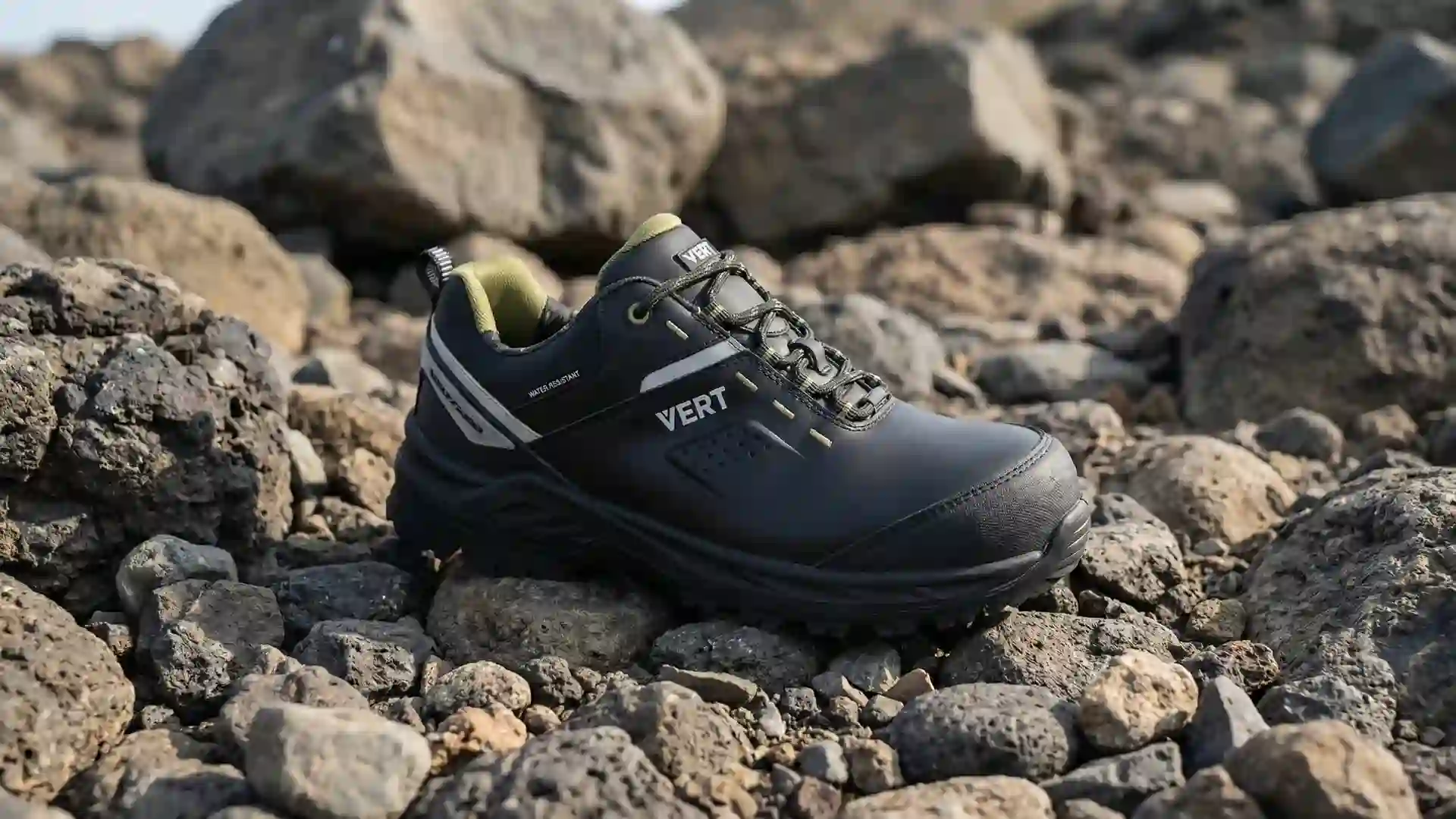
Work Shoes Wholesale – OEM for Industrial Brands
Steel toe, composite toe and slip-resistant work shoes for industrial buyers. CE and ASTM certified, MOQ from 50 pairs, shipped FOB Xiamen since 2005.
Certified Work Shoes, Built to Your Spec
We build safety shoes for the job: reinforced toe caps, slip-resistant outsoles and puncture-proof midsoles, tested against ASTM and CE. Our own testing lab and partner factory network let us work as manufacturer, private label supplier and wholesale source at once. Every pair is made for the floor it will be worn on — construction, logistics, food processing, cold stores — not for a catalogue photo.
What We Guarantee
Rated for 18+ months of daily wear
MOQ from 800 pairs per style
Your designs stay confidential
98% shipped on or before the confirmed date
Tiered pricing, 3–20% off at volume
Design to container, one supplier
Work Shoes FAQ – Wholesale & OEM
1.1 What’s the difference between steel toe and composite toe safety shoes, and which one is better for my team?
The difference comes down to material, weight and conductivity. A steel toe takes more impact and suits heavy work like construction or mining, but it is heavier. A composite toe uses fibreglass and similar non-metals, so it is lighter and non-conductive — better for warehouse staff and anyone on their feet all day. Tell us the job and we will recommend one; both meet international safety standards.
1.2 Are your waterproof safety shoes for construction durable and up to industry standards?
Yes. A waterproof membrane and multi-layer construction give them a high water rating, so they hold up to rain and site seepage while still breathing enough to avoid stuffy feet. The upper resists abrasion and the outsole is oil-proof, which is what a long day on a construction site actually demands.
1.3 What anti-slip standards do your work boots meet, and how do you ensure anti-slip performance in different situations?
Our work boots are rated to EN ISO 20345:2011 SRC, SRB and SRA, which covers dry, wet and oily ground. Beyond the label, we tune the tread to the site: deeper lugs for rough construction ground, oil-resistant rubber for factory floors. Anti-slip performance is tested before mass production, not assumed.
1.4 How warm do your insulated work boots for cold weather keep feet, and what materials do you use for insulation?
Our insulated work boots hold warmth for more than 8 hours between -20℃ and 0℃. The build uses high-loft insulation and a composite fleece lining that are warm without turning bulky, plus a windproof upper and an insulated sole so cold does not climb up from the ground. Made for outdoor construction, cold storage and winter site work.
1.5 How durable are your full grain leather work boots, and how can I maintain them to make them last longer?
Full-grain leather sits at the top layer of the hide, so it resists cracking and keeps its shape, and with normal use these boots run 2–3 years. The surface is treated for water and abrasion resistance. To stretch that: apply leather oil regularly, keep them out of direct sun, avoid acids and alkalis, and clean dirt off and air-dry rather than force-dry.
1.6 Do your ankle support work boots for heavy industry really protect ankles well, and what support designs do they have?
Yes. The upper rises 10–15cm above the ankle with a flexible internal frame that limits the roll which causes sprains. The support is soft and elastic, so it does not dig in over a long shift, and the boot meets the EN ISO 20345:2011 ankle protection requirement.
1.7 Are your lightweight work shoes for warehouse staff really light and comfortable, and how much do they weigh?
Yes. Each shoe weighs 280–350g, about 30% under a traditional safety shoe. An EVA and rubber composite sole cuts weight while staying abrasion-resistant and shock-absorbing, the upper is thin breathable mesh, and a memory-foam insole helps on long shifts. Toe protection and puncture resistance are still there.
1.8 How do your breathable work shoes for long shifts stay breathable while keeping feet safe, and how breathable are they?
A multi-layer structure gives them a breathability rate above 800mm/s, so sweat moves out quickly. The upper is perforated mesh and the lining wicks moisture to the surface. That breathability does not weaken the toe protection or puncture resistance, which is what makes them work on 12-hour factory and logistics shifts.
1.9 What materials do you use for oil-resistant work shoes, and how do you test their oil resistance?
The sole is nitrile rubber, which resists mineral and vegetable oil without swelling or losing shape. We verify it with a 24-hour immersion in No. 3 white oil and machine oil: volume change stays under 5%, which meets ASTM D471. An oil-proof coating on the upper makes cleaning easier.
2.1 Are you a professional ODM manufacturer for European brand safety shoes, and what ODM services do you offer?
Yes. We have run ODM programs for European brands since 2005, covering design through mass production. We work from your brand position, target market and safety standard, develop the samples, and select materials that clear European rules — GRS recycled content included. Production is set up to your quality and delivery targets.
2.2 Do you offer work boots private label service with low MOQ, and what’s the minimum order quantity?
Yes. MOQ depends on the style and how custom it is. A standard style starts at 50 pairs, and you can mix several styles in one order. A new design from scratch starts at 200 pairs per style, which covers sample development. Wholesale customers with a planned annual volume can negotiate lower.
2.3 Can you design custom work shoes for retail chains, and what customization options do you have?
Yes. We design whole programs for retail chains — style, function, logo — so the same range works for shelf sales and staff uniforms. That might mean a lighter shoe for service staff and a certified safety shoe for the warehouse. Waterproofing, low weight, logos, colours and exclusive lasts are all in scope, and we have launched these ranges quickly before.
2.4 How long does it take to make safety shoe samples, and what’s the sample development process?
Samples take 7–15 working days depending on how custom the request is. We confirm style, material and function, prepare the raw materials, then cut, sew and bond the sample and test its performance before sending it to you. We revise until it is right. If you need it sooner, we can compress the schedule for an extra fee, with five days as the fastest.
2.5 What’s the bulk pricing for work boots for wholesalers, and how is the price calculated?
Pricing is tiered on volume and built from the style, the material, the safety rating and how much customisation you add. Logo printing and colour matching are quoted separately. Discounts run 3–5% at 500–1,000 pairs, 8–12% at 1,000–3,000, and 15–20% above 3,000, with exclusive pricing open to negotiation. Every quote lists its cost items.
2.6 Do your work shoes have BSCI certification, and what other compliance certifications do you have?
Yes. Our partner factories hold BSCI certification, and we carry the paperwork the EU, US and Middle East markets ask for: social compliance (BSCI, SEDEX), environmental (GRS, OEKO-TEX) and product safety (EN ISO 20345:2011, CE, ASTM F2413). All documents are available for your compliance review.
2.7 Can you print logos on safety shoes for brands, and what logo customization methods do you have?
Yes. Embroidery suits leather or fabric uppers and holds up without fading; heat transfer handles detailed, multi-colour logos; hot stamping gives a metallic finish; laser engraving is the minimal option for casual work shoes. Whichever you pick, the logo does not compromise the shoe's safety performance.
2.8 Do you offer custom color options for work boots, and are there any limits to color customization?
Yes. More than 20 standard colours — black, brown, navy and so on — ship quickly. Pantone matching is available for custom colours at 300 pairs per colour, confirmed against a physical sample. The only real limits are what the material and process allow. We will also advise on matching upper, sole and lining to your brand palette.
2.9 Can I customize the size range for work shoes, and what size services do you provide?
Yes. Standard sizing runs EU 35–48, US 5–14 and UK 4–13, with special sizes such as 49–52 or 34–35 on request. We also adjust the last width to regional foot shapes, which matters for European and Middle Eastern markets, and can print dual metric and imperial size markings. Sizing is verified during sampling.
3.1 How long does it take to ship bulk safety shoes from China to the USA, and what shipping methods do you have?
To the USA it is 15–35 working days depending on the method. Sea freight, at 25–35 days, is the cheaper route for large orders; air freight at 15–20 days is for when you need stock sooner. Both run through forwarders we use regularly and come with tracking.
3.2 How do you ship work boots to the Middle East, and how long does air freight take?
Air freight to the Middle East usually runs 10–18 working days, with local partners handling clearance and delivery. Sea freight is the cheaper option for large orders at 30–45 days. Tell us the quantity and deadline and we will pick the right one.
3.3 What’s the sea shipping lead time for work shoes to Europe, and how do you ensure on-time delivery?
Sea freight to Europe is 20–30 working days depending on the port. We book with carriers on stable European routes and slot production ahead of sailing so the goods are ready when the vessel is. Tracking is shared, and if something unexpected comes up you hear it from us first.
3.4 What’s the import duty for safety shoes in Germany, and can you help with duty calculation?
For Germany, expect roughly 6–8% duty on the goods value plus 19% VAT on the duty-inclusive total. The exact rate depends on the product code and current customs rules. Our logistics team can estimate it before you order so your budget holds.
3.5 Can you help with work boots customs clearance in the UK, and what documents do I need?
Yes. We prepare and pre-check the commercial invoice, packing list, CE certificate, BSCI audit report and certificate of origin against UK requirements, so the container clears without sitting at the port.
3.6 Do your work shoes have CE certification for the EU market, and can you provide certification documents?
Yes. CE marking is required to sell work footwear in the EU, and ours is issued against EN ISO 20345:2011, covering the safety performance tests that matter. Full certification documents are available for your records and for customs.
3.7 What’s your return policy for defective B2B safety shoes?
If goods arrive with a real defect, such as a broken sole or a failed safety test, apply within 30 days of receipt with photos or video. Our quality team verifies it, then we refund or replace free of charge. Return freight on confirmed defects is on us.
3.8 What if the work boots are the wrong size, can I get a replacement?
If the size is wrong, apply within 15 days of receipt and keep the pairs unused in their original packaging. Send a photo of the size label, we confirm the error, and once the wrong pairs come back we ship the correct size with the return freight shared.
3.9 What after-sales support do you provide for overseas clients with work shoes?
Our after-sales team works in English on your time zone and replies within 24 hours by email, phone or WhatsApp. Questions on quality, use or maintenance are all fair game, and we keep providing technical support for as long as you stock the product. Large accounts also get scheduled follow-ups.
Who We Work With














We work with global brands and smaller labels on the same terms: your spec, your branding, and the same QC whether the order is 50 pairs or 50,000.