
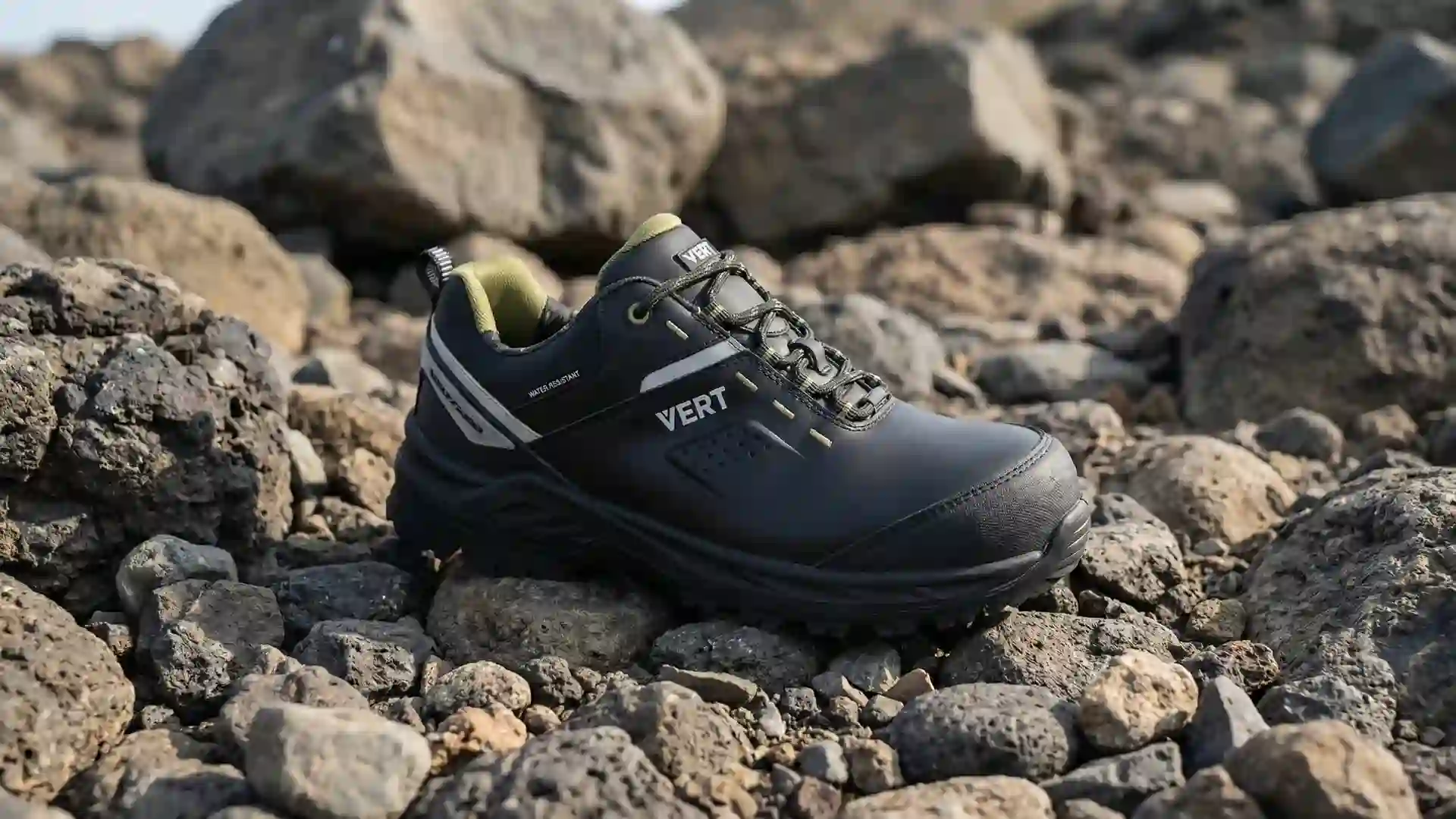
Composite Toe Safety Shoes – ASTM F2413, MOQ from 50 Pairs
OEM & ODM composite toe safety shoes from a BSCI-audited factory in Jinjiang — non-metallic toe caps, EN ISO 20345 and ASTM F2413 testing, MOQ from 50 pairs
Composite Toe Safety Footwear from a Factory That Tests Every Batch
Fibreglass and Kevlar instead of steel
The toe cap is moulded fibreglass or Kevlar composite. It takes the same 200J impact as a steel cap, adds no metal to the shoe, and trims real weight — which matters on ESD floors and at airport metal detection.
Built for a ten-hour shift
Mesh uppers, a shock-absorbing EVA midsole and a footbed shaped to the arch. The point is a shoe people still want on at hour ten, so they keep the protection on instead of kicking it off.
Tested to EN ISO 20345 and ASTM F2413
Every style is tested to EN ISO 20345 and ASTM F2413 for toe impact, compression, penetration and slip. Third-party lab reports ship with the order, so your compliance file is ready before the container lands.
OEM and private label solutions run from a 3D mock-up through tooling, branding and packaging. You get a shoe carrying your label that passes CE, and we keep the last on file so repeat orders match the first run.

Private label composite toe boots, your logo and last
You send the brand direction and the safety spec; we develop the last, build the sample and run the bulk under your label. Logo, box, hangtag and colourway are yours, and the shoe still carries the EN ISO 20345 mark.

Lighter on the foot, same protection
The composite cap and a slim sole take real weight out of the shoe. Staff in warehouses, food plants and logistics get a boot they can walk in all day without giving up toe or penetration protection.

Wholesale runs, steady supply
Distributors get consistent builds across repeat runs — one spec sheet, one QC standard — whether the order is 800 pairs or 30,000. We hold the last and the material list so the tenth container matches the first.

No metal anywhere in the shoe
Composite toe, composite or Kevlar midsole, no metal anywhere. That means no cold transfer in winter, no static build-up, and a shoe that clears airport metal detection. The cap still meets the impact standard.

QC on every batch, not a sample
In-house QC checks toe-cap seating, sole bond and stitching on every batch, then runs a final AQL 2.5 inspection. Anything that fails is pulled before packing. Fewer returns for you, and a warranty rate we will put in the contract.

OEM built for industrial buyers
Design, material sourcing, tooling, production and freight sit with one team. As volume grows we move the order onto more lines and hold the spec, so scaling up does not mean re-approving the shoe.
From tech pack to container: the nine stages your order moves through
Trading since 2005 · partner factories in Guangdong, Zhejiang and Fujian · ODM and OEM runs for brands and wholesalers

Shoetec Partner Shoe Factory
Partner lines in Guangdong, Zhejiang and Fujian | runs from 800 to 100,000 pairs | QC at every stage before the carton is sealed

Shoe Material Purchasing
OEKO-TEX and GRS certified mills | material cost quoted line by line, no hidden markup

Shoe Design
ODM and OEM development | 3D mock-up before any leather is cut | built to your tech pack or sample

Cutting
Digital nesting keeps material waste down | first-piece inspection at the cutting table

Stitching
12 stitches per cm on load-bearing seams | inline check every 30 minutes

Bottom Attaching
Cold cement or vulcanized soles | slip and abrasion tested to EN ISO 20345 | complaint rate under 0.5%

Lasting Operation
Hand and machine lasting | lasts sized for EU, US or UK feet

Shoe Packings
Your box, hangtag and barcode | packed to EU and Middle East customs rules

Logistics & Distribution
FOB Xiamen or DDP door-to-door | tracking shared after departure | 7-21 days to core markets
Composite Toe Work Shoes FAQ
1.1 What's the weight difference between composite toe boots and steel toe boots?
Composite toes run roughly 100-150g lighter per shoe. A single composite toe boot from our line sits under 300g; the same build with steel is 350-450g. The saving shows up on concrete floors — less weight at the end of a ten-hour shift means less foot fatigue, and the boot stays flexible, so you can crouch and climb without the toe dragging.
1.2 Are your waterproof composite toe work boots suitable for wet workshops?
Wet workshops, food plants and wash-down areas are what these are built for. We use a waterproof membrane with sealed seams, and a rubber cup outsole with an SRC-rated tread so grip holds when the floor is wet. The upper wipes clean with a damp cloth. Tell us whether the shop is rinse-down or splash-only and we will spec the membrane to match.
1.3 Do you have insulated composite toe boots for cold storage work?
Yes. For cold stores we line the boot with 200g or 400g thermal wadding, add a thermal insole, and keep the toe cap non-metallic so it does not pull heat out of the foot. Feet stay warm through a normal shift down to about -20℃. For colder rooms we can move to a 600g lining — tell us the temperature range your staff work in and we will match it.
1.4 Are there breathable composite toe work shoes suitable for summer?
For summer we build a knit or mesh upper with a wicking lining instead of a padded leather upper. Air moves through the forefoot, sweat leaves, and the composite cap still takes the same 200J impact. The pair stays comfortable on a hot day without giving up toe protection. We can add a perforated footbed for warmer markets.
1.5 Are your composite toe work shoes slip-resistant enough for warehouse use?
Yes. These are tested on wet and oily tile and meet SRC slip resistance. The tread uses a deep, multi-directional pattern that sheds dust and water rather than packing up, which is what actually matters on a warehouse floor. The rubber is abrasion-resistant too, so the grip lasts through months of walking on concrete.
1.6 Do you offer low-cut composite toe work shoes for easier movement?
We make low-cut versions of the same shoe. Cutting the collar away frees the ankle for climbing, kneeling and long walks, and the toe cap is identical to the high-cut build. Choose low-cut for drivers and pickers, high-cut for sites where ankle roll is a real risk.
1.7 What's the weight range of your lightweight composite toe safety shoes?
Across the lightweight range a single shoe is 250-290g, all under 300g. The cap is fibreglass or Kevlar composite rather than steel, which is where most of the saving comes from, and the sole is a slim EVA-and-rubber unit. None of that changes the rating — they still meet EN ISO 20345 and ASTM F2413.
1.8 Do your lightweight composite toe safety shoes have memory foam insoles?
Many styles ship with a removable memory-foam insole. It moulds to the arch, spreads pressure under the heel, and takes the sting out of standing all day. Because it lifts out, you can swap in an orthotic or replace it once it flattens. If you want a specific insole spec for your brand, we can source or develop it.
1.9 Are your lightweight composite toe safety shoes flexible enough for long walks?
The upper and sole are built to bend with the foot. We use a flex-grooved sole and a soft-collar lining, so the shoe rolls through the step instead of fighting it. Staff doing 15,000+ steps a day notice it most. Durability holds up as well — the flex zone is reinforced, which is exactly where cheaper safety shoes crack first.
1.10 Do you have anti-static lightweight composite toe safety shoes for electronics factories?
Yes. For electronics plants we add a static-dissipative insole and a conductive path through to the outsole. The composite cap is non-metallic, so there is no metal to hold a charge, and the resistance sits in the 10⁶-10⁹ ohm band most ESD floors require. Send us the plant ESD spec and we will match the resistance.
2.1 Do you provide ODM service for composite toe boots for European brands?
Yes. We do ODM for European safety brands: you give us the positioning and target price, and we handle last development, upper design, testing and mass production to EN ISO 20345. We have been making footwear in Jinjiang since 2005 and work to EU REACH and CE requirements. You get the design files and an approved sample before bulk starts.
2.2 Can I get private label composite toe work shoes with our brand logo?
Yes. Our private label services cover your logo on composite toe work shoes — embroidery, heat transfer or laser engraving, whichever suits the upper. We hold your logo file and apply it the same way on every pair, and it is tested to survive cleaning. The box, hangtag and barcode are printed too. A logo-only run starts at 50 pairs per style.
2.3 Do you provide custom design services for lightweight composite toe safety shoes for retailers?
Retailers come to us with a shelf position and a price point, and we design the range around it. That covers casual, professional and specialised looks, plus the sole, last and lining behind them. Safety, comfort and durability stay in the spec, and we run samples so you judge the actual shoe rather than a drawing.
2.4 What's the minimum order quantity (MOQ) for composite toe work shoes?
MOQ is 50 pairs for a standard composite toe work shoe, which lets a new brand test the market without a large commitment. A fully custom design, with its own last and tooling, starts at 200 pairs per style. Colours and sizes can be mixed within the order, and long-term wholesale accounts can negotiate further.
2.5 How long does it take to deliver composite toe boot samples?
A composite toe boot sample takes 7-10 working days, and a simple logo or colour change can be quicker. You inspect it, and we revise until it is right before anything goes to bulk. Because the sample is built on the production line with production materials, what you approve is what ships.
2.6 Are your lightweight composite toe safety shoes BSCI and CE certified?
Yes. Production sits in BSCI-audited factories, and the shoes are tested to EN ISO 20345 for CE. BSCI covers labour and factory conditions; CE covers the toe cap, penetration and slip performance. We hand over the audit summary and the lab test reports for your compliance file.
2.7 Can I get custom color composite toe boots for our corporate clients?
We do Pantone matching on the upper, sole and trim. The limit is usually the material — some recycled or coated leathers will not hold a bright hue, and we flag that early. Custom colour runs start at 300 pairs per colour, and we send a colour sample before bulk.
2.8 Do you offer composite toe work shoes with a wide size range?
Standard sizing covers EU 35-48, US 5-14 and UK 4-13. We can add EU 49-52 or 34-35 on request, and we widen the last for markets that need a broader forefoot. Sizes are checked against a last-measurement table during sampling, so the fit matches the market rather than the label. Browse our complete product catalog for the styles we currently hold.
3.1 How do you ship bulk composite toe boots from China to Germany?
Bulk composite toe boots go from China to Germany by sea or air. Sea freight is 20-30 working days and the cheaper option on volume; air freight is 10-15 working days when you need stock fast. We quote FOB Xiamen, or DDP to your German warehouse, with tracking from departure.
3.2 Can you arrange air freight for composite toe work shoes to the UAE?
Air freight to the UAE runs about 10-18 working days. We work with forwarders who clear Dubai and the other emirates regularly, so customs paperwork is routine. Sea freight to Jebel Ali is also available and cheaper if the timeline allows.
3.3 How long does sea shipping take for lightweight composite toe safety shoes to the UK?
Sea freight to the UK is 30-40 working days port to port, depending on whether it lands at Felixstowe, Southampton or London Gateway. We book with carriers on stable UK routes and share tracking, so you plan the launch around the arrival date rather than guess at it.
3.4 What's the import duty for composite toe boots in France?
Safety footwear into France usually attracts 6-8% duty on the goods value, plus 20% VAT on the duty-paid value. The exact rate depends on the tariff code and the upper material. We put the HS code on the commercial invoice and can help you estimate landed cost before you commit.
3.5 Can you help with customs clearance for composite toe work shoes in the USA?
Yes. We handle US customs paperwork for composite toe work shoes — commercial invoice, packing list, and the ASTM F2413 test report US buyers ask for. Documents are checked before the container leaves, so clearance is not held up at the port.
3.6 Are your lightweight composite toe safety shoes compliant with EN ISO 20345 for the EU market?
Yes, the full range is tested to EN ISO 20345. That covers 200J toe impact, 15kN compression, penetration resistance and slip performance — the four things an EU safety buyer checks first. We provide the test report and CE documentation for your file and for customs.
3.7 What's your return policy for defective B2B composite toe work shoes?
For a manufacturing defect, tell us within 30 days of receipt with photos or a short video. Our QC team verifies it, and we replace the affected pairs or raise a credit. We cover return freight on confirmed defects. Because every order is made to your spec, we do not take returns for change of mind.
3.8 Can I get a replacement if the composite toe boots have wrong specifications?
If we shipped the wrong size, colour or spec, ask for a replacement within 15 days, unused and in the original carton. Send a photo of the size label or spec sheet, we check it against your order, and we send the correct pairs. Freight on specification errors is shared.
3.9 Do you provide overseas after-sales support for lightweight composite toe safety shoes?
We keep an English-speaking after-sales team reachable in your working hours by email, phone or WhatsApp, and we reply within 24 hours. Questions about wear, cleaning or performance go to the same team that built the order, so you get an answer from production rather than a call centre. Repeat accounts also get scheduled follow-up.